EleutherAI began in July 2020 as a Discord server. A handful of researchers — Connor Leahy, Leo Gao, Sid Black — named it after the Greek word for liberty and set out to build open versions of models that, at the time, only a few companies could inspect from the inside. By the end of that year they had released The Pile, an 886-gigabyte curated text dataset. Within eighteen months came GPT-J and then GPT-NeoX-20B, for a while the largest openly available GPT-3-class model anyone could download. They declined outside funding at the outset and trained on donated compute. A great deal of the open material the field later took for granted — the datasets, the reference implementations, the first open safety probes — was assembled this way, by volunteers on borrowed hardware, and the collective did not incorporate as a nonprofit research institute until 2023, two and a half years in.
Source EleutherAI project history.
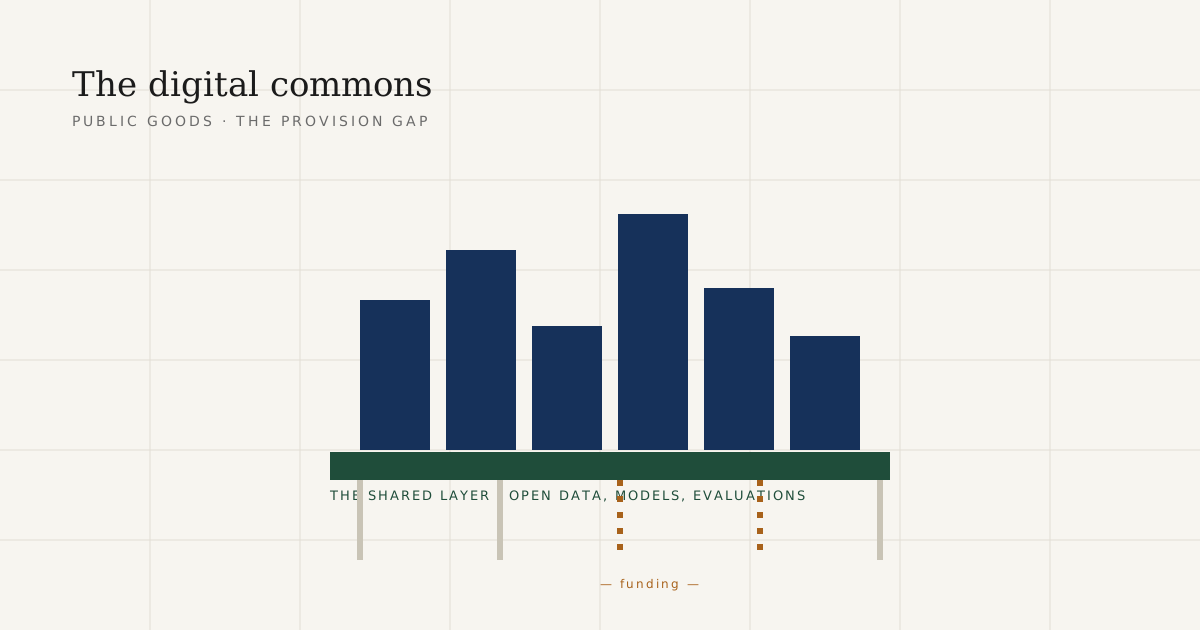
That is a strange way to build critical infrastructure, and it is the ordinary way to build a public good. Open models, open training data and open safety evaluations share two properties economists have named for a century. They are non-excludable: once they exist, it is hard to stop anyone from using them. And they are non-rival: one more person downloading The Pile does not leave less of it for the next. Put those together and the incentive math is not mysterious. The benefit is spread thinly across everyone who builds on the commons; the bill for maintaining it lands on someone specific; so the bill tends to go unpaid, and the work gets done by whoever is willing to go uncompensated — until they stop.
The recognition problem is largely solved
For a decade the argument was whether any of this mattered — whether open models were a curiosity or a foundation. That argument is over. The United Nations University now makes the case that AI systems themselves can be treated as digital public goods and spells out what governing them that way would require. The Digital Public Goods Alliance, the body that vets what qualifies, has moved into assembling the open datasets that public-interest AI would need. Position papers with real signatories argue that if open source is going to matter in AI it has to go properly public — funded deliberately as a commons rather than surviving as a byproduct of some company's competitive strategy. Even Andreessen Horowitz, arguing the opposite case for private-sector leadership, treats open models as strategic assets worth defending. The live disagreements are about who should lead. Almost no one still argues the commons is unimportant.
The stakes are not sentimental. When the shared layer is thin, everyone downstream inherits its weaknesses: a biased or poorly documented dataset propagates into every model trained on it, and an evaluation that no longer reflects current systems gives false comfort across the whole field at once. A commons is a single point of leverage — which is its value when it is healthy and its danger when it rots. Concentration is the alternative, and it is already the default. If the open layer withers, capability does not vanish; it consolidates inside the few firms that can afford to build privately, which is the outcome open source existed to prevent.
And money has started to move. At the Paris AI Action Summit in February 2025, the French government, Google, Salesforce and a cluster of foundations — MacArthur, Ford, the Patrick J. McGovern Foundation — launched Current AI, a public-interest initiative that opened with $400 million and a stated ambition to raise $2.5 billion over five years. Ten more governments signed on. Its three declared pillars are, almost word for word, the commons: expanding access to high-value open datasets, defending open standards and tools, and building frameworks for auditing and accountability. On paper this is the thing the position papers had been asking for.
Source Current AI launch, Paris AI Action Summit, February 11, 2025.
Governments are moving on the hardware, too. Canada committed roughly two billion dollars to a Sovereign AI Compute Strategy in late 2024, and other states have announced their own. But compute is the part of the commons that most resembles an ordinary asset — it is excludable and rival, you can meter it and charge for it. It is precisely the layer the market already knows how to fund. The datasets, the evaluations, the documentation, the unglamorous curation — the genuinely non-excludable layers — are the ones that keep getting done for free until they don't.
The gap is provision, not discovery
This is where the money and the attention still miss. A dataset is not a monument; it decays. Links rot, licences are contested, the text ages relative to the world it was scraped from, and the standards for what belongs in a training corpus tighten faster than volunteer maintainers can keep up. Safety evaluations are worse: a benchmark is only meaningful against the models it was built to probe, and models change monthly. The people who do this work are the scarcest input of all, and they are on term-limited grants or on nights and weekends. The question a funder actually faces is not whether open datasets matter — that is settled — but who is paid to keep this one current, and what quietly breaks in the first year that no one is.
Evaluations deserve their own alarm. Open safety benchmarks are how outside researchers, regulators and smaller labs check what the frontier is actually doing; they are the instruments of accountability the position papers keep invoking. But a benchmark saturates — models learn to pass it, or it simply ages past the behaviors that now matter — and a saturated benchmark that no one has refreshed does not fail loudly. It keeps returning reassuring numbers while measuring less and less. Unmaintained evaluation is worse than absent evaluation, because it looks like oversight while providing none.
The Pile already shows the wear. Its Books3 component — a large slice of the original corpus — was removed in 2023 after copyright complaints, so the dataset a great deal of early open work trained on cannot now be reassembled in the form it once had. That is what decay looks like in practice: not a dramatic collapse but a quiet, permanent narrowing, one licence dispute and one departed maintainer at a time. Nothing about it was unforeseeable. It was simply no one's funded job to prevent.
- 1BuiltVolunteers assemble and release it on donated compute
- 2AdoptedIndustry and researchers train on it as a default
- 3AgesLinks rot, licences are challenged, standards shift
- 4UnmaintainedThe grant ends; the maintainers take jobs
- 5DegradesIt quietly narrows and cannot be rebuilt as it was
- 1BuiltVolunteers assemble and release it on donated compute
- 2AdoptedIndustry and researchers train on it as a default
- 3AgesLinks rot, licences are challenged, standards shift
- 4UnmaintainedThe grant ends; the maintainers take jobs
- 5DegradesIt quietly narrows and cannot be rebuilt as it was
Source Prevention Lab, illustrative.
But won't the companies just do it?
The strongest objection is that the market is already provisioning open models without anyone funding a commons at all. Meta's Llama family, Mistral, the open-weight releases out of DeepSeek and others have put capable models within reach of anyone, at no charge, published by companies for their own strategic reasons. If open weights keep arriving as a free byproduct of competition, why does anyone need to fund a commons deliberately?
Because a corporate release and a public good are not the same object, even when they look identical on a download page. A model released as strategy can be un-released, relicensed, or left to rot the moment the strategy changes; its openness lasts exactly as long as it is useful to the firm. It arrives without the boring connective tissue a commons needs — the documented provenance, the maintained evaluation suites, the datasets whose licences will survive a lawsuit, the governance that decides what gets fixed and by whom. Open weights are the visible tip. The commons is everything underneath that makes them safe to build on, and that layer has never once been produced as a profitable byproduct. It is produced by people who are paid to produce it, or by volunteers until they burn out.
Persistence
A strategic release can be withdrawn or relicensed at will; a funded commons is maintained on purpose.
Maintenance
Weights ship and freeze; datasets and evaluations need continuous upkeep no one profits from.
Provenance
Corporate corpora are often opaque; a commons carries documented, litigable licences.
Governance
A firm decides for itself; a commons needs a body accountable for what gets fixed.
Source Prevention Lab.
There is a softer version of the market objection — that philanthropy and summits will cover the gap. But philanthropy funds launches, not upkeep. It is drawn to the new dataset, the new institute, the announceable thing, and structurally averse to the recurring line item that keeps a five-year-old corpus current. Current AI's own framing is telling: three pillars about building and expanding, aimed at raising $2.5 billion for new public-interest capacity. That is the right ambition. It is also, almost by design, not a maintenance budget. The commons does not mainly need to be discovered, or even expanded. It needs to be kept.
None of this is expensive by the standards of the industry it underwrites. Maintaining a major dataset, refreshing an evaluation suite and paying the few people who understand both is a rounding error against a single frontier training run. That is what makes the shortfall galling rather than tragic: it is not that the money does not exist, but that it flows to the excludable, ownable, announceable layers and around the shared one. Preventive spending here is cheap, legible and unglamorous — three qualities that, together, reliably keep a thing unfunded.
A foreseeable, financeable shortfall
This is the pattern worth naming, because it recurs in a different domain each time: a harm to a public good that is entirely foreseeable from evidence already in plain view, where the warning is credible and cheap and the response is slow and unfunded. Nobody has to discover that open datasets age or that maintainers leave. It is knowable now, this year, from the visible state of the projects the whole field depends on. The failure, when it comes, will not be a failure of foresight. It will be a failure of provision — a bill everyone could see coming that no one was assigned to pay.
The recognition is done and the first real money is on the table. That makes the remaining question narrower and harder, not easier. It is no longer whether the commons matters but who owns its upkeep once the summit is over and the launch is a year old — and whether $2.5 billion aimed mostly at building new things will leave anything for the far less photogenic work of keeping the old things alive. The Pile is five years old. Someone will have to answer for the sixth.