Executive summary
Five years after the February 2021 seizure of power, Myanmar's conflict has caused tens of thousands of deaths and displaced 3.6 million people — the highest level on record — with more than 16 million in need of humanitarian assistance, according to the UN. Multi-phase elections held in December 2025 and January 2026 produced a nominally civilian administration led by the military authorities, an outcome the UN and many governments did not recognise as free or fair. A federated opposition and ethnic-resistance coalition holds or contests much of the country and rejects any settlement that preserves military supremacy. Battlefield lines have settled into a stalemate that neither side can readily break.
The harder problem is not the design of a settlement but that none of the actors who would have to accept one — the military authorities, the opposition coalition, and, as an influential external stakeholder, China — currently sees sufficient reason to. Each judges that time is on its side. These are not the conditions under which parties compromise; they are the conditions under which parties keep fighting.
The reframe that follows from this is straightforward. The immediate objective is not to table a peace plan but to shape the cost-benefit calculus of the decisive actors — to help build the 'ripeness' a settlement requires. Outside actors have far more influence over the inputs to ripeness — humanitarian access, calibrated economic measures, the economic floor under the authorities, informal channels, the cohesion and readiness of the opposition, and the credibility of external guarantees — than over the final political bargain. The settlement architecture remains the destination; it should be prepared and quietly pre-negotiated, but it is not the opening ask.
The human cost
The case for acting now rests first on arithmetic. The 2026 UN humanitarian plan finds 16.2 million people — over 45% of the assessed population — in need of life-saving assistance, including 5 million children; more than 12 million face acute hunger. Internal displacement reached 3.6 million by late 2025 and is projected to rise toward 4 million. Independent monitoring groups have recorded high civilian casualties over the period. The 2026 appeal sought roughly $890 million to reach a fraction of those in need and remains significantly underfunded, with several major providers scaling back. This matters strategically: the donor-financed holding action that keeps people alive while diplomacy works is itself under strain, which shortens the available timeline rather than lengthening it.
The arithmetic cuts both ways. Every year the war continues carries a heavy humanitarian cost, which raises the bar for any party choosing to prolong it. But the same arithmetic warns against a poorly built peace — one that freezes a fragile partition or leaves core grievances, including those of the Rohingya, unaddressed — which can cost more over time than it saves now. The conclusion is not 'peace at any price,' but that the cost of delay belongs explicitly on the scale beside the cost of compromise.
A stalemate each side reads as momentum
The military authorities hold the central heartland, the main cities, and the principal economic corridors, but firmly control only a minority of national territory; ethnic armed organisations and post-2021 defence forces hold or contest much of the periphery. The military has the advantage in the air and in heavy weapons but cannot reconquer lost ground; the resistance can take territory but lacks the air defence, heavy weapons, and unified command to hold the centre. On a static reading, this is a textbook mutually hurting stalemate — the classic precondition for a settlement.
But ripeness is about perception, not maps. A conflict is 'ripe' only when the parties themselves perceive a mutually hurting stalemate and a way out. Myanmar currently fails both tests. Recent battlefield movements are read in some quarters as momentum on one side, and the resistance reads its own territorial spread the same way. Each discounts its costs and inflates its prospects, and the result is not a search for an exit but a wager that time favours it — the psychology that prolongs wars. If the central obstacle is the absence of perceived ripeness, then the central task of outside actors is to alter perceptions and incentives until at least two of the three decisive actors conclude that continued war is worse than a negotiated path.
The reframe: building the conditions
Donors and regional actors have limited control over the final political bargain but considerable influence over the inputs to ripeness, and the strategic shift this brief recommends is to concentrate effort there. Five levers are within reach. Raise the cost of continued war for those who can end it — principally through the economic dimension and by conditioning external support on engagement, rather than through battlefield escalation outsiders cannot control. Lower the perceived risk of negotiating, through credible, pre-negotiated guarantees on security, calibrated accountability, and protected interests. Increase the visible reward of settlement, by quantifying and publicising the reconstruction and sanctions-relief 'peace dividend' so that constituencies can see the upside. Build the machinery in advance — informal channels, a pre-designed monitoring mission, and the technical readiness of the opposition — so that a window, once open, is not wasted. And protect the population while waiting, since sustained humanitarian access is a no-regrets investment that saves lives and preserves the social fabric a future settlement will need.
Actor incentives
The military authorities, under present conditions, have little reason to negotiate: they hold the institutions, the banks, substantial commercial assets, and existing constitutional guarantees. They would contemplate a transition only if several conditions became true at once — economic pressure they cannot offset; a credible, calibrated approach to accountability that protects the institution and the rank and file and so reduces existential fear; external support that is conditional rather than open-ended; and a face-saving path that protects core interests and converts a drawdown into a managed transition. The task of outside actors is to help bring these conditions into being, not to assume the authorities will value future guarantees over present power.
The opposition coalition, for symmetrical reasons, also has limited reason to sign now: while it believes momentum favours it, and while battlefield success strengthens hardliners over negotiators, it has little incentive to accept a continued military role. It would move only if the federal-democratic endpoint were genuinely guaranteed and difficult to reverse; if it secured interim self-government and revenue in the areas it administers as a down-payment; if external backing were made conditional on good-faith engagement; and if the mounting cost of governing its own areas strengthened pragmatists. Exogenous shocks can change such calculations — as the 2004 tsunami did in Aceh — and Myanmar's 2025 earthquake and deepening economic strain are potential analogues that diplomacy can use, though not manufacture.
China is an especially influential external actor, and treating it as one neutral guarantor among several would be a mistake. Its core interests — border stability, trade, and the economic corridor running to the Indian Ocean — must be addressed explicitly in any durable settlement, and its constructive engagement in a guarantors' channel is important to whether any ceasefire holds. Any viable design should guarantee those corridor and border-trade interests explicitly, give China a recognised seat in a guarantors' channel so it is invested rather than sidelined, and recognise that its willingness to apply conditional pressure on the parties is a significant variable.
Among regional and Western actors, the incentives run the other way. Thailand, as a front-line state, has the strongest immediate interest in stabilisation and unmatched cross-border access. Indonesia and Japan bring regional weight and working channels. The United States and the European Union hold economic and reconstruction leverage. None of these actors can deliver a settlement alone; collectively, and with China constructively engaged, they can shift the calculus of those who can. The uncomfortable conclusion is that the three actors indispensable to a settlement currently see limited incentive to move, while those most willing cannot deliver it on their own — which is the precise, evidence-based reason the conflict is not yet ripe, and why the work of the next 12–24 months is to change those incentives rather than to circulate a peace plan.
The economic dimension
Wars end when the political, military, and economic pictures align. In Myanmar the military picture is stalemated and the political picture is frozen; the economic picture is where the parties' calculations are most movable. Independent estimates indicate the currency has lost roughly 80% of its value since 2021, inflation has run above 30%, and the World Bank projects continued contraction amid earthquake damage and conflict-driven supply shocks. Economic interests are concentrated, and concentration makes them a constituency whose cost-benefit calculus can shift.
Three implications follow. Calibrated economic measures — targeted rather than blunt, with relief sequenced explicitly against verified de-escalation — are more likely to move the calculus than any redrafting of a framework. A costed, public estimate of the reconstruction financing, sanctions relief, and returning investment a credible settlement would unlock turns 'peace' from an abstraction into a balance-sheet proposition for business and the wider elite. And because external economic support is what sustains the floor, the constructive engagement of major partners, China included, is central to whether economic pressure translates into movement at all.
A 100-day agenda for building the conditions
These are concrete, largely no-regret measures achievable within a 100-day window; none requires any party to commit to a final settlement, and several save lives regardless of whether negotiations ever begin. In the first month, the priorities are to sustain and expand cross-border and cross-line humanitarian access; to press for localised ceasefires and pauses in designated humanitarian zones; to open multiple discreet channels to pragmatists on each side and to key armed organisations; and to bank early confidence-building steps such as prisoner releases.
In the second month, the focus shifts to incentives: calibrating economic measures as a sequenced system in which pressure and relief move together; publishing a costed peace-dividend estimate; engaging China early in a dedicated guarantors' channel that trades explicit corridor and border guarantees for constructive pressure; and beginning narrow, expert-level technical talks on humanitarian modalities and monitoring design that build habits of cooperation without demanding political concessions.
In the final stretch, the work turns to architecture: investing in the cohesion and inclusive representation of the opposition — ethnic nationalities, women, the displaced, and a meaningful place for Rohingya concerns; pre-building the monitoring and verification machinery with regional partners so it can deploy the moment a ceasefire is signed; and quietly pre-negotiating the elements of the settlement so it can be assembled quickly when a window opens, without publicly demanding that parties enter it before they are ready.
The destination: a phased architecture
When ripeness is closer, the settlement should satisfy four constraints so that it reads as a mutual conversion rather than a surrender: face-saving symmetry, so each side can claim vindication; sequenced reciprocity, so no one concedes first; a time-limited and shrinking military role; and external guarantees. The closest design analogues are Northern Ireland and Aceh, which offer lessons that transfer: leaving the precise final shape of federalism to a guaranteed future process so both sides can sign without conceding the endpoint; allowing parties to meet obligations as the process runs rather than as preconditions; substituting deep self-government and revenue-sharing for both secession and central domination; and using independent, regionally anchored verification rather than an external imposition.
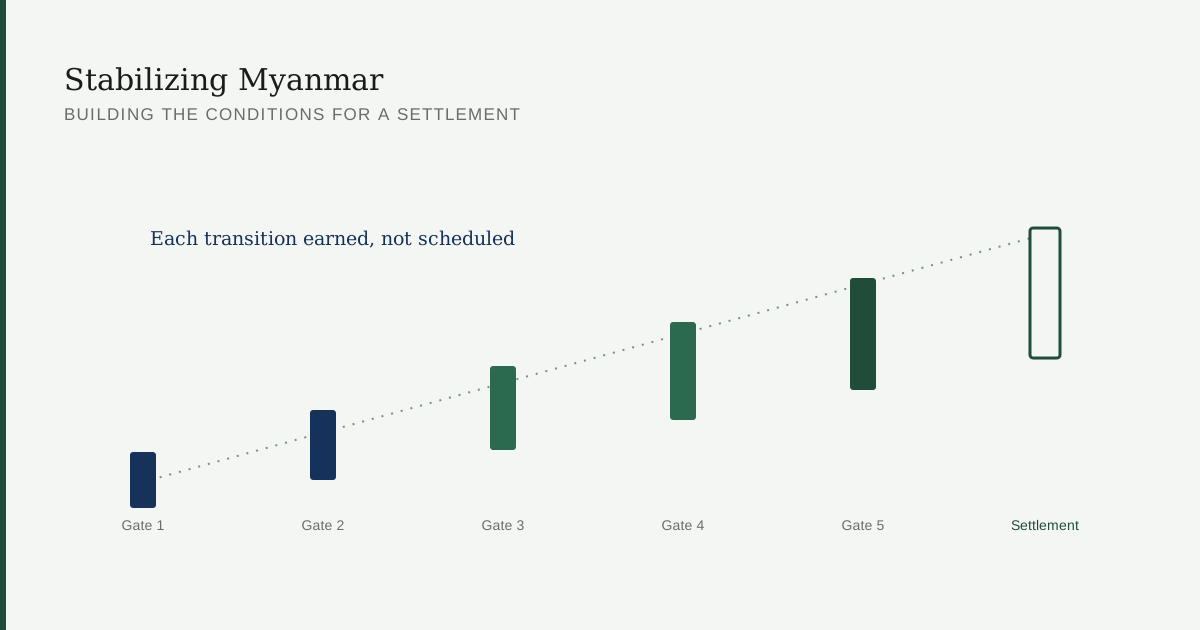
The sequence should be expressed as conditional gates rather than a calendar, because fixed dates invite missed-deadline crises: each transition is triggered by a verified condition, not a date. Confidential channels and holding humanitarian pauses open the way to framework talks; a signed framework and a reciprocated ceasefire trigger the deployment of a monitoring mission; independent verification that the ceasefire is holding unlocks an inclusive transitional authority and interim self-government; verified cantonment thresholds and constitution-drafting unlock phased arms management and a transitional-justice mechanism; and a ratified constitutional referendum and observed elections trigger the conditional sunset of reserved prerogatives and a full handover.
Those sunsets should be conditional rather than fixed. Few institutions surrender reserved powers on a set date, so each prerogative should lapse upon fulfilment of a defined, independently verified condition — reserved security-ministry control ending when cantonment thresholds are certified, reserved legislative seats ending when the referendum is ratified — with an independent body adjudicating whether each condition has been met and a pre-agreed dispute mechanism. The monitoring mission should be specified in advance: a regionally anchored, primarily civilian ceasefire-monitoring mission on the Aceh model, with host-party security guarantees, an independent verification commission with a public reporting mandate, and a joint arbitration body — modular in design, so that a breach in one area does not collapse the whole.
Managing spoilers
Peace processes fail less from poor drafting than from actors who benefit from continued conflict, and these must be identified and managed deliberately. They include hardline factions on either side that fear that any exit is a betrayal or a prosecution risk; armed organisations worried about losing autonomy, territory, or status in a centralised deal; and interests tied to war economies for which disorder is directly profitable. The management approaches differ accordingly: front-loading institutional and calibrated-justice guarantees while empowering pragmatists; ensuring an inclusive, modular design with regional self-government and revenue-sharing so peripheral actors gain from peace; and pairing sequenced transitional economic plans with alternative livelihoods and law-enforcement cooperation. External stakeholders whose interests are engaged are better managed through a guarantors' channel that gives them a stake in the outcome than treated as fixed opponents.
If negotiation does not succeed
Credibility requires planning beyond the preferred outcome, and the humanitarian track is the no-regrets floor under every alternative. If ripeness cannot be built within a meaningful horizon, outside actors should hedge against several trajectories: a prolonged stalemate, against which they should institutionalise humanitarian access and keep channels warm for a later window; a frozen conflict along current lines, against which local ceasefires and area-by-area governance can reduce violence even without a national settlement; deepening external dependence, against which regional and other partners can maintain counter-balancing engagement and economic alternatives; a protected-enclave model, whose legal and logistical architecture can be built now and doubles as a confidence-building measure; and further fragmentation, which calls for contingency planning with neighbours on displacement and cross-border risks. Across every scenario, two investments pay off regardless: sustained humanitarian access, and discreet channels to all sides. A strategy anchored on these survives the collapse of its own best case, which is the test of a serious one.
Roles and sequencing
The convening weight should sit with actors who have leverage: ASEAN, which brings legitimacy and the regional seat and is best placed to lead a monitoring mission, and Thailand, the front-line state with cross-border access. Indonesia is well suited to co-designing the monitoring mission on the Aceh model and championing deep-autonomy formulas short of secession; Japan can serve as a bridge and a major reconstruction financier; and the United States and the European Union can hold and calibrate economic measures as a sequenced incentive while guaranteeing reconstruction and transitional-justice terms. China should be engaged as an influential stakeholder in a dedicated guarantors' channel, trading explicit corridor and border guarantees for constructive pressure. Norway's comparative advantage is discreet facilitation, continuity, and secretariat capacity — deliberately not the public face.
The sequence is: now, over the coming year, build the conditions — sustain and expand humanitarian access, calibrate economic measures with a published peace-dividend estimate, open multiple discreet channels, bring China into a guarantors' channel, invest in opposition cohesion and inclusion, and pre-design the monitoring architecture. Then, as conditions allow, prepare the destination — quietly pre-negotiate the conditional-gate framework and conditional-sunset mechanisms, and stand up the monitoring mission on signature. Throughout, build regional and national ownership so that leadership migrates from the donor coalition to ASEAN and Myanmar's own institutions.
The settlement architecture is sound, but architecture is not the binding constraint. The binding constraint is that the actors who must sign do not yet want to. The defensible strategy is to spend the coming period building the conditions — economic, humanitarian, diplomatic, and institutional — under which negotiation becomes the rational choice for all of the decisive actors. Lead with the conditions; hold the destination ready. That is the difference between a sound analysis and an implementable policy.