On the eve of New Hampshire's January 2024 primary, thousands of Democrats answered the phone to hear Joe Biden tell them to stay home. “Save your vote for the November election,” the voice said. Biden had said no such thing. The call was an AI clone, commissioned by a political consultant named Steven Kramer and built with an off-the-shelf voice tool for a reported few hundred dollars, and it was identified as fake within a day. The response looked, for a while, like a system working. The Federal Communications Commission moved to fine Kramer $6 million and, within weeks, ruled AI-generated voices in robocalls illegal. Lingo Telecom, the carrier that delivered the call, settled with the FCC for a million dollars. The fake was caught fast. What happened next is the part worth studying.
Source FCC actions; New Hampshire v. Kramer; 2026 campaign reporting.
Because the accountability that looked like it had arrived largely came apart. In June 2025 — a year and a half after the call, and long after the election it targeted was settled — a New Hampshire jury acquitted Kramer on all twenty-two criminal counts, eleven felony charges of voter suppression and eleven misdemeanor counts of impersonating a candidate, despite his having openly admitted commissioning the call. The $6 million FCC penalty, a separate civil matter, was reported still unpaid. Strip away the fast early headlines and what remains is thinner than it first appeared: a swift ban on one narrow method, a carrier's settlement, and a criminal case a jury declined to convict on. The detection was real. The deterrence is largely notional.
Detection was never the bottleneck
This is the pattern that generalizes. Synthetic media is, more often than not, flagged fast — within hours of surfacing, with attribution sometimes following in days. The tooling to spot fakes has kept rough pace with the tooling to make them. In the 2026 US midterm campaigns, AI fakes are described by reporters as a routine feature of the landscape rather than a shocking intrusion; the Brennan Center has moved on from asking whether the threat is real to gauging which specific guardrails would blunt it. The scarce resource is not knowing that a clip is fake. It is getting an authorized actor to do something enforceable about it before it has finished its work.
The asymmetry underneath is what makes the interval decisive. The New Hampshire call reportedly cost a few hundred dollars and an afternoon to produce; the public response consumed a federal agency, a state criminal prosecution, a civil settlement and eighteen months of court time, and still resolved to an acquittal. That ratio does not favor the defender. When a fake is cheap to make, believed instantly and expensive to counter, the side that has to wait for due process loses on tempo even when it is right on the merits.
There is a second-order effect that widens the gap further. As fakes become routine, their most durable damage is no longer any single deception but the ambient doubt they create — the so-called liar's dividend, in which a genuine recording can be waved away as a probable fake. That doubt does not resolve on the detector's timeline; it lingers. It means the response interval is not only about catching the fakes that are fake, but about being able to authenticate the real thing fast enough that denial does not become a free move. Provenance answers both problems with one mechanism; after-the-fact labeling answers neither.
The interval that decides the outcome
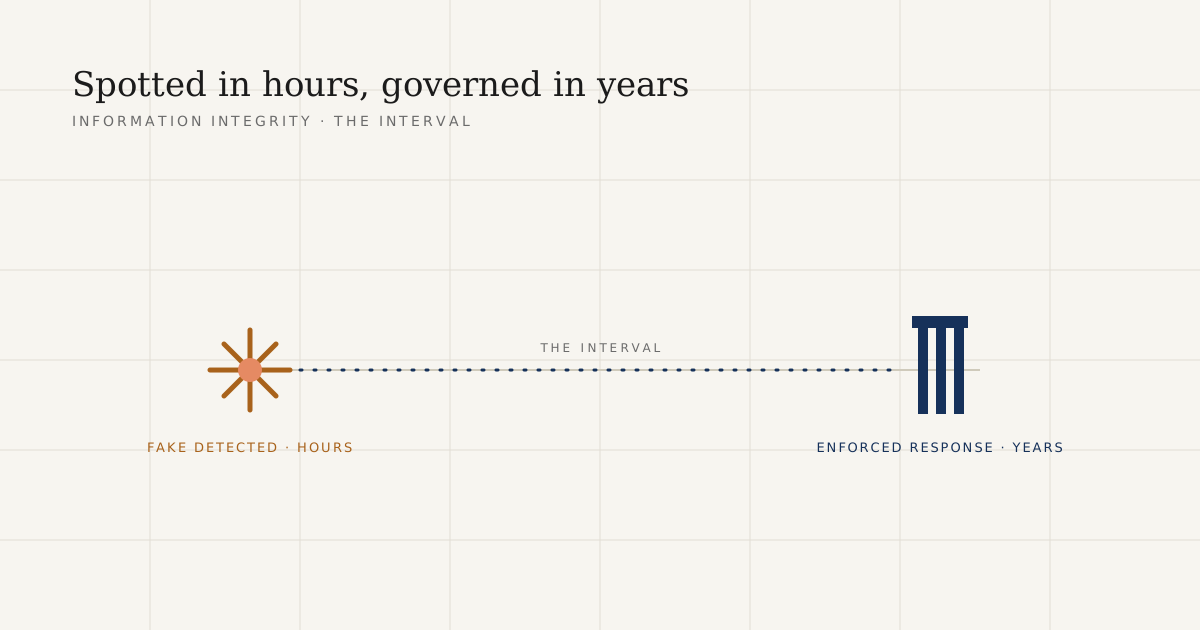
Call it the response interval — the time between a fake being credibly identified and an authorized actor being able to do something that bites. On one end, detection: hours. On the other, consequence: in the New Hampshire case, a criminal verdict eighteen months later, and an acquittal at that. Everything that matters to a voter happens in the gap. A fake that is believed for a single news cycle before an election has already worked, whatever a court decides the following year. The contest between manipulation and integrity is being fought inside that interval, and most of the law we have addresses the wrong end of it.
- 1PublishedThe fake goes out; belief forms immediately
- 2FlaggedIdentified as synthetic within hours
- 3AttributedTraced to a source within days
- 4InvokedA rule or prosecution is brought — months later
- 5ResolvedVerdict at eighteen months: acquittal
- 1PublishedThe fake goes out; belief forms immediately
- 2FlaggedIdentified as synthetic within hours
- 3AttributedTraced to a source within days
- 4InvokedA rule or prosecution is brought — months later
- 5ResolvedVerdict at eighteen months: acquittal
Source Prevention Lab; New Hampshire timeline.
The rules on offer divide cleanly into two kinds, and the distinction is the whole game. Some shorten the interval: provenance that travels with a file so a clip's origins can be checked in the moment, platform duties to act on a flagged item within the hour, standing takedown mechanisms that do not wait for a court. Others merely describe it: labels applied after the fact, disclosure requirements with no fast enforcement, criminal statutes that punish — sometimes, if a jury agrees — long after the damage is done. Both look like “doing something about deepfakes.” Only the first kind changes what a voter sees before they vote.
Provenance in the file
Content credentials carried from creation let origin be checked in the moment, before belief sets.
Fast platform duty
An obligation to act on a flagged clip within the hour attacks the interval directly.
After-the-fact labels
A warning applied once a fake has circulated arrives after its work is done.
Criminal statutes
Deterrence in principle, but slow, high-bar, and — as New Hampshire showed — uncertain.
Source Prevention Lab.
A global patchwork, pulling both ways
The world is now legislating this, unevenly and in both directions at once. Texas criminalized election deepfakes as early as 2019 with SB 751, among the first jurisdictions anywhere to try; other US states have followed one legislative session at a time, producing a map of mismatched definitions and thresholds. The European Union's AI Act, through its Article 50 transparency rules and an accompanying code of practice on marking AI-generated content, is pushing provenance toward the file itself — the interval-shortening approach, at continental scale. Denmark has gone further and stranger, amending its copyright law in 2025 to give people a property-like right in their own face and voice, so a deepfaked likeness becomes an infringement its subject can move against directly. Canada introduced legislation in June 2026 to make social media services and AI chatbots safer, putting obligations on platforms rather than waiting for a comprehensive AI statute.
A patchwork is not merely untidy; it is itself a source of delay. A platform facing fifty state definitions, a federal rule and a different regime in every export market has every incentive to default to the slowest, most defensible response — wait for a formal complaint, wait for legal clarity, wait. Fragmentation pushes the whole system toward the describe-it end of the spectrum, because acting fast under one jurisdiction's rule can create liability under another's. The interval widens in the gaps between authorities, which is exactly where a well-resourced bad actor operates.
And then there is the current running the other way. In January 2025 Meta ended its third-party fact-checking program in the United States, replacing it with community notes and explicitly widening what its platforms will carry. Whatever the merits as speech policy, the effect on the response interval is unambiguous: it lengthens it, moving verification from a standing institutional function to an ad-hoc, crowd-paced one. The same year European regulators tried to push consequence closer to the moment of publication, the largest distributor of information in the West pushed it further away. The interval is not a fixed target. It is being widened and narrowed at once, by different hands.
Provenance over prosecution
The New Hampshire case is, in the end, an argument for a particular emphasis. Prosecution failed there — not because no one knew who did it, since he admitted it, but because the criminal law is a slow, high-bar, back-end instrument and juries are unpredictable. Provenance and platform duty are front-end instruments. A content-credentials standard that stamps origin into a file at creation, carried by cameras and editing tools and honored by platforms, does not need a conviction to work; it needs adoption. That is a coordination problem, which is a more tractable thing than proving criminal intent to twelve jurors. The lesson of Kramer is not that the law is toothless. It is that the teeth are at the wrong end of the timeline.
The objections are serious and worth stating plainly. Provenance can be stripped or spoofed; a standard only helps against fakes that route through compliant tools, not the ones built to evade them. Fast takedown duties invite over-removal and hand private companies — the same ones already criticized for their moderation — still more editorial power over political speech, with real First Amendment friction in the United States. And a right in one's own likeness, the Danish route, collides with satire, parody and news. None of these is a reason to keep aiming only at the slow end. They are reasons the front-end instruments have to be designed with as much care as the back-end ones — which is precisely the work a patchwork built one state and one statute at a time is not doing.
Acting inside the hour is a capacity question before it is a legal one. It requires someone — an electoral authority, a platform's trust-and-safety function, a standing rapid-response body — funded and authorized in advance to verify and act, not assembled after a fake is already trending. This is the preventive posture worth arguing for across domains: the credible warning is cheap and early, and the decisive variable is whether an authorized response is financed and standing before the harm or improvised after it. Elections are the clarifying case because the deadline is fixed and public. The interval cannot be litigated open; it has to be engineered shut in advance.
So the honest question is not whether deepfakes can be detected. They can, usually, and fast. It is whether any authorized actor can be made to act inside the hours that decide an election, rather than the years that decide a court case. New Hampshire caught its fake in a day and is still, two years on, without a conviction or a paid fine to show for it. The 2026 races are generating fakes faster than that, and they will not wait eighteen months for the verdict on any of them.