How many pandemics were prevented before COVID-19? Bird flu, swine flu, SARS, Ebola — most people remember only the outbreaks that escaped containment. Few remember the ones that didn't. The same is true of disasters. How many lives have been saved because a cyclone warning arrived early, a flood barrier held, a vaccination campaign succeeded, or a fragile peace agreement prevented violence? We rarely celebrate these victories because, by definition, prevention leaves no dramatic images behind. Its greatest success is that nothing happens.
That presents a profound problem for modern governance. Governments, international organizations, corporations, and even voters tend to reward visible response rather than invisible prevention. Political leaders receive credit for rebuilding after disasters, not for investing in resilience years before. Emergency budgets appear overnight; prevention budgets struggle for approval. Heroic rescue commands headlines. Quiet competence rarely does.
Yet the defining crises of our age are seldom true surprises. The vulnerabilities that triggered the 2008 global financial crisis were documented long before markets collapsed. Pandemic preparedness experts spent years warning that another respiratory virus was inevitable before COVID-19 emerged. Climate scientists have projected rising temperatures, extreme weather, and sea-level rise with increasing confidence for decades. Early-warning systems routinely identify famine risks months before starvation occurs. Conflicts are often preceded by years of documented political deterioration.
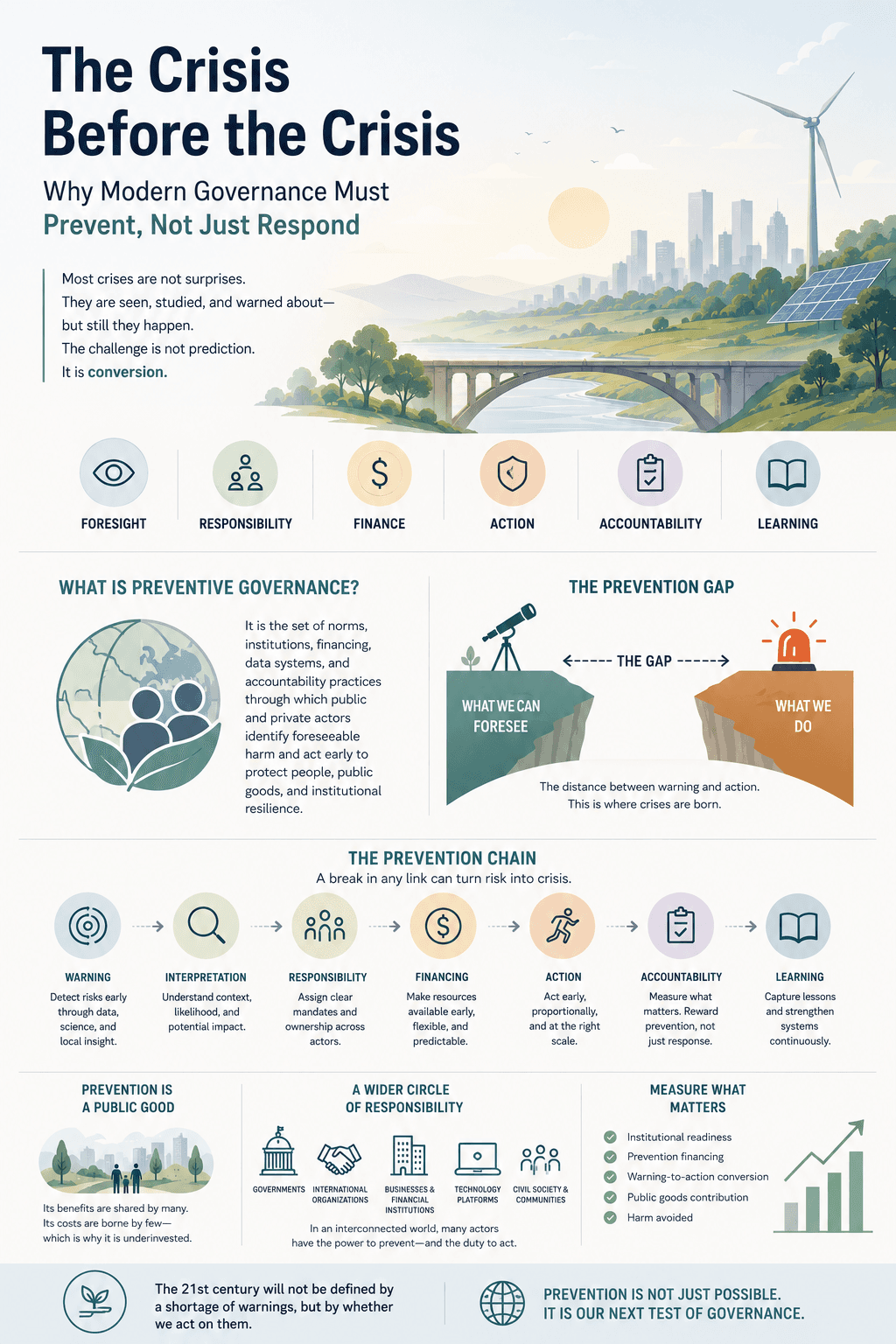
The problem is no longer one of detection. It is one of conversion: turning foresight into authorized, financed, and politically legitimate action before harm becomes crisis. That challenge demands a new framework — what I call preventive governance.
The Prevention Gap
Preventive governance is the set of institutions, norms, financing mechanisms, data systems, and accountability practices through which public and private actors identify foreseeable harm and act early to protect people, public goods, and institutional resilience. At its heart lies the Prevention Gap: the distance between what institutions can foresee and what they are willing or able to prevent.
The framework is not built from scratch. It connects five intellectual traditions that have largely evolved in parallel. From the Responsibility to Protect comes the principle that sovereignty entails responsibility — a logic preventive governance extends beyond states and beyond mass atrocity, to any institution with the capacity to foresee and reduce serious harm. From human security comes the recognition that the true measure of security is the protection of people from the threats that actually shorten and diminish their lives. From public-goods theory comes the economic explanation for why prevention is chronically neglected: its benefits are shared widely, difficult to exclude, and often realized only as crises that never occur, so every actor tends to underinvest.
From decades of work on early warning and early action, the lesson is equally clear: collecting better information is not enough. Modern institutions rarely fail because nobody saw the danger. They fail because warning does not automatically generate authority, financing, or political will. Finally, development finance demonstrates that capital deployed before crisis consistently delivers greater returns than money spent after collapse.
Responsibility to Protect
Sovereignty entails responsibility — extended beyond states and mass atrocity to any institution able to foresee and reduce serious harm.
Protecting people, not just states
The true measure of security is protection from the threats that actually shorten and diminish people's lives.
Why prevention is neglected
Its benefits are widely shared, hard to exclude, and often realised only as crises that never occur — so every actor underinvests.
Information is not enough
Institutions rarely fail because no one saw the danger; warning does not automatically generate authority, financing, or will.
Capital before crisis
Money deployed before a crisis consistently delivers greater returns than money spent after collapse.
Source The Prevention Lab.
The Architecture of Delay
If the intellectual foundations already exist, why does prevention remain so elusive? Because late action is often the rational outcome of today's institutional incentives. Preventive action requires spending money now to avoid uncertain costs later. It demands political courage in the face of incomplete information. Leaders risk criticism for acting “too early” far more often than they are rewarded for disasters that never materialize. Bureaucracies prioritize immediate emergencies over slow-moving threats. Mandates are fragmented across agencies. Responsibility is diffused. Funding arrives only after disaster declarations.
Collectively, these dynamics create an architecture of delay — a system that systematically pushes action beyond the point where it would have been cheapest and most effective. Preventive governance addresses this by treating prevention not as a vague aspiration but as an operational chain: warning, interpretation, responsibility, financing, action, accountability, and learning. Every foreseeable crisis that occurs despite prior warning represents a chain that broke at a specific link.
- 1WarningA credible signal that serious harm is foreseeable.
- 2InterpretationThe signal is read correctly and judged serious.
- 3ResponsibilityAn actor is mandated to own the response.
- 4FinancingResources are authorised before the crisis.
- 5ActionEarly intervention is actually taken.
- 6AccountabilityActors answer for acting — or for failing to.
- 7LearningThe system improves for the next cycle.
- 1WarningA credible signal that serious harm is foreseeable.
- 2InterpretationThe signal is read correctly and judged serious.
- 3ResponsibilityAn actor is mandated to own the response.
- 4FinancingResources are authorised before the crisis.
- 5ActionEarly intervention is actually taken.
- 6AccountabilityActors answer for acting — or for failing to.
- 7LearningThe system improves for the next cycle.
Source The Prevention Lab. Every foreseeable crisis that occurs despite prior warning is a chain that broke at a specific link.
This distinction matters even more because today's risks are increasingly interconnected. Climate shocks trigger displacement. Displacement strains fragile states. Fragility increases the likelihood of conflict. Financial instability compounds political instability. Disinformation erodes trust in democratic institutions. Artificial intelligence creates entirely new categories of systemic risk. In such an environment, every missed opportunity for early action increases the cost — and reduces the options — available later.
Responsibility Beyond Government
Preventive governance therefore expands responsibility beyond governments alone. Technology companies influence the integrity of information ecosystems. Banks and insurers often possess the earliest indicators of climate and financial risks. Development finance institutions determine whether investments build resilience or deepen vulnerability. Artificial intelligence developers shape technologies whose societal impacts may become irreversible long before regulation catches up. The question is no longer whether these actors exercise governance. Increasingly, they already do. The question is whether governance will recognize the preventive responsibilities that accompany such influence.
The final obstacle is measurement. Prevention remains politically weak because its successes are largely invisible. Institutions therefore require ways to make avoided harm legible: indicators of institutional readiness, prevention financing ratios, warning-to-action conversion rates, and estimates of harm avoided. None of these metrics will ever be perfect. Counterfactuals rarely are. But imperfect measurement is preferable to a world in which prevention carries no measurable value while response receives all the credit.
A Standard for the Next Century
The twenty-first century will not be defined by a shortage of warnings. It will be defined by whether societies can act upon them. Some crises will always remain unforeseeable; perfect prediction is neither possible nor desirable. But when credible warnings exist, when institutions possess the capacity to respond, and when foreseeable harms are allowed to become avoidable disasters, those outcomes should no longer be treated as unfortunate inevitabilities. They should be recognized for what they are: failures of governance.
The next generation of governance must judge institutions not only by how effectively they respond to crises, but by how consistently they prevent them. The societies that master that transition will not necessarily appear more dramatic or more heroic. Their greatest achievements will often be invisible. And that may be the surest sign that they succeeded.