Working PaperJune 5, 2026· 34 min read
Preventive Governance: A Framework for Acting Before Harm Becomes Crisis
Preventive GovernanceStrategic ForesightPublic Goods
The foundational working paper of The Prevention Lab. It argues that the central challenge of modern governance is not ignorance but conversion — the repeated failure to turn foresight into authorized, financed, and legitimate action before harm becomes crisis. It develops preventive governance as a doctrine drawing together five traditions (the responsibility to protect, human security, public-goods theory, early warning, and development finance), locates the recurring failure in the Prevention Gap, treats prevention as a public good whose provision now implicates private as well as public power, and sets out where reform and measurement should concentrate.
Many of the crises that define our era were not surprises. They were failures of organized anticipation — of turning what was known into what was done.
Consider the texture of the last two decades. A global financial system whose fragilities were named by regulators and economists before 2008. A respiratory pandemic that preparedness boards had rehearsed and warned of for years before 2020. A warming climate whose trajectory has been modeled, with widening confidence, since the 1980s. Famines that early-warning systems flag months ahead of mass death. Conflicts preceded by years of documented escalation. In each case the dominant public narrative afterward is one of shock. In each case the more accurate narrative is one of foresight that failed to become action.
This distinction matters because it relocates the problem. If crises were genuinely unforeseeable, the appropriate response would be better detection: more sensors, more data, more prediction. Detection matters, and this paper takes it seriously. But the evidence of the modern record points elsewhere. The binding constraint is rarely that no one saw the risk. It is that seeing did not translate into a mandate to act, money to act with, the legitimacy to act early, or the institutional will to bear a certain cost now against an uncertain and invisible benefit later. The problem is one of conversion, and conversion is a governance problem.
The economics of that failure are stark wherever they have been studied. Across disaster risk, public health, and conflict, the returns to acting before a threshold are routinely estimated at several times the cost of acting after it; anticipatory measures are cheaper not by a margin but by a multiple. Yet the structure of budgeting, attention, and credit ensures that the expensive path is the default. An institution that spends to prevent absorbs a certain cost today and receives, at best, a statistical non-event in return. An institution that waits and then responds absorbs a larger cost later but receives gratitude, visibility, and the unambiguous narrative of rescue. Until that asymmetry is corrected, rational institutions will keep choosing the path that is worse for the people they serve.
Preventive governance is the name this paper gives to the capacity to make that conversion reliably. It is the capacity of states, international organizations, development finance institutions, private firms, and civil society to identify foreseeable harm early, coordinate responsibility for it, finance action against it, and protect the public goods at stake — before risks become crises. It is broader than any of the established prevention fields. It is not only conflict prevention, not only disaster risk reduction, not only resilience. It is a general governance doctrine for preventing avoidable harm and enabling public good across domains that are usually treated separately but fail in the same way.
The stakes of getting this right are rising, because risk itself is changing shape. The threats that matter most are increasingly systemic and cascading: a climate shock that triggers displacement that strains a fragile state that collapses into conflict; a financial tremor that propagates through interlinked balance sheets; a synthetic-media campaign that erodes trust in an election whose contested result destabilizes a region. Cascading risks punish late action with particular severity, because each unbroken link in the cascade raises the cost and narrows the options for the next. In an age of compounding interdependence, the premium on acting early is not constant; it grows.
Preventive governance is not a claim that all harm is preventable, nor a counsel of perfect foresight. Some shocks are genuinely unforeseeable, and a system that treated every speculative risk as a mandate to act would exhaust itself and forfeit legitimacy. The doctrine is narrower and more disciplined: it concerns foreseeable harm — risks that credible, mandated bodies have named, judged serious and probable, and called action on — and it asks why such warnings so reliably fail to produce action in time. Nor is it a single new institution or a call to centralize authority. It is a way of seeing a problem that cuts across existing institutions, and a set of design principles and instruments for closing the distance between foresight and action wherever that distance appears.
Institutions do not act late because they are careless. They act late because the structure of incentives, cognition, and bureaucracy makes late action the path of least resistance.
The first task of a theory of preventive governance is to explain its opposite. If prevention were merely a matter of good intentions, exhortation would suffice. It does not, because the tendency to act late is not an accident but a property of how institutions are built. Naming the components of that tendency — the architecture of delay — is what makes them addressable.
The deepest source is the asymmetry of cost and benefit in time. The costs of prevention are near-term, concentrated, and certain: a budget line, a regulatory burden, a political fight today. Its benefits are deferred, diffuse, and counterfactual: a crisis that does not occur, a harm no one experiences, a headline never written. No leader is thanked for the pandemic that did not spread or the election that was not destabilized. This is the prevention paradox, familiar from public health, generalized to governance: the measures that produce the greatest collective benefit confer little visible, attributable credit on those who enact them.
Cognition compounds the problem. Bounded rationality means decision-makers triage attention toward the urgent over the important, and toward vivid, recent events over slow-moving and statistical ones. A risk that is gradual, probabilistic, and not yet salient struggles to command the scarce resource of senior attention, however severe it is on the merits.
Political economy adds a third layer. Blame-avoidance is a stronger driver of bureaucratic behavior than credit-claiming, and prevention offers little defensible credit while exposing actors to the risk of being wrong. Acting early on an uncertain risk invites the charge of alarmism or waste if the risk does not materialize; waiting until the harm is undeniable is safer, because by then no one can be blamed for having moved too soon. In a competitive international environment, restraint can also look like unilateral disadvantage: each jurisdiction fears that binding rules will simply relocate the activity, so caution becomes a collective-action trap.
Finally, mandates are fragmented. Foreseeable harms rarely respect the boundaries of a single agency, ministry, or institution. Responsibility is diffuse; the warning sits with one body, the authority to act with another, the money with a third, and the accountability with none. Diffuse responsibility is functionally equivalent to no responsibility at all.
A democratic dimension underlies all of these. Publics, too, reward visible rescue over invisible prevention. Electorates mobilize around the disaster on the screen, not the one averted; coverage follows the response, not the quiet competence that made a response unnecessary. Leaders read these signals accurately and allocate accordingly. This is not a failure of democracy so much as a feature of how salience and accountability interact, and it means closing the prevention gap is partly a communicative task: building public understanding that the crises that never happen are achievements, and that the institutions which produce them deserve the credit usually reserved for those that clean up afterward.
The crucial feature of these forces is that each is individually rational. The official who defers a costly intervention, the minister who prioritizes the visible emergency, the firm that declines to internalize a diffuse externality, the agency that waits for certainty before committing its budget — none is behaving foolishly given the incentives it faces. Delay is the equilibrium of a system in which the rewards for prevention are weak and the penalties for early error are sharp. This is why exhortation fails and why the remedy must be structural: to change the behavior, one must change the incentives, mandates, and financing that make delay rational in the first place.
Cascading risk sharpens the cost of that equilibrium. When hazards are independent, late action is merely expensive. When they are coupled — when one materialized risk raises the probability of the next — late action forfeits the chance to break the chain at its cheapest link. The architecture of delay was built for a world of discrete emergencies. It performs worst precisely in the interconnected world we now inhabit, where the gap between foresight and action is not a fixed tax on welfare but a compounding one.
Preventive governance is not invented from nothing. It inherits and adapts five established traditions, each of which contributes one load-bearing idea.
The responsibility to protect, articulated by the International Commission on Intervention and State Sovereignty in 2001 and endorsed at the 2005 World Summit, established a principle of lasting power: sovereignty entails responsibility. Authority over a population is not only a right but a duty of care. Preventive governance generalizes this move beyond the state and beyond atrocity. Its adapted principle is that institutional authority entails preventive responsibility — that any actor with the capacity to foresee and forestall serious harm bears a corresponding duty. That includes governments, but also corporations, platforms, regulators, and multilateral and financial institutions whose decisions shape who is exposed to harm and who is protected from it.
The human security tradition, advanced in the United Nations Development Programme's 1994 Human Development Report and by the Commission on Human Security in 2003, shifted the referent object of security from borders to people. Security means protecting individuals and communities from the threats that actually shorten and degrade their lives. Preventive governance adopts this lens and gives it a metric: prevention should be measured by harm avoided and capability protected, not by activity or expenditure. This is what allows a single framework to span conflict, food, health, climate, displacement, information integrity, and economic shocks — domains unified not by their mechanisms but by their consequence for human security.
Since Samuelson's formalization in 1954, economics has understood that certain goods — non-rival and non-excludable — will be undersupplied by markets and individual actors, because no one can capture their full benefit. The literature on global public goods extends this to problems whose benefits cross borders and generations. Preventive governance makes a specific claim within this tradition: prevention is itself a public good, and a peculiarly undersupplied one, because its benefits are not only diffuse but delayed and invisible. This is the framework's strongest economic argument, developed in full in Section 6.
From preventive diplomacy to famine early-warning systems to forecast-based humanitarian financing, a long practitioner tradition has established that institutions frequently know about risks before they act on them. Its hard-won lesson is the one at the center of this paper: the central failure is not the absence of warning but the failure to convert warning into authorized, financed, and legitimate action. Early-warning systems proliferated on the assumption that better information would produce better action. It often did not, because information is only the first link in a longer chain.
Development finance institutions have learned, expensively, that prevention requires capital before crisis, not only relief after collapse — through crisis windows, contingent credit, and anticipatory instruments that disburse on a forecast rather than a body count. Preventive governance draws a normative conclusion: development finance institutions and their public shareholders should be evaluated not only by financial return and development impact, but by their contribution to systemic risk reduction and the protection of public goods. Capital that arrives before the threshold is worth a multiple of the same capital after it.
These traditions are not seamless, and the doctrine does not pretend otherwise. The responsibility to protect remains contested, precisely because a duty attached to capacity can be invoked as a pretext for intervention; human security has been criticized as so capacious that it risks meaning everything and therefore nothing; public-goods arguments can rationalize provision that is captured by its providers. Preventive governance inherits these tensions and disciplines them in two ways: by confining its scope to foreseeable harm with an identifiable duty-bearer, and by insisting that responsibility be paired with accountability, so that the authority to act early is always matched by answerability for acting — or failing to.
Together these five traditions supply the spine of the doctrine: a duty of care attached to capacity, a human-centered measure of success, an economic account of why prevention is undersupplied, a diagnosis of where it breaks, and a theory of how to finance it. What has been missing is the connective tissue — a single framework that treats them as one problem. That is the contribution this paper attempts.
Foreseeable harm is the responsibility of a crowded and uncoordinated field. The doctrine's job is to make that field legible — to ask, for any given risk, who can act and who must.
Preventive governance is not the property of any single institution. It is a property of the system formed by many, each holding a fragment of the capacity to anticipate and act. States remain central: they hold the legitimate authority to regulate, tax, and coerce, and most preventive action ultimately runs through public power. But the modern terrain is far wider. Multilateral institutions supply mandate, convening power, and the standing to name risks that no single state will name alone. International financial institutions hold both surveillance capacity and the financing instruments that determine whether prevention is affordable. Development finance institutions shape, through where they lend and what they require, whether investment builds resilience or fragility.
Beyond the public sphere, a set of private actors now exercises what can only be called governance functions. Technology platforms structure the information environment in which democratic and social risks incubate. Insurers and reinsurers price physical risk and, in doing so, send some of the earliest and most honest signals about where harm is concentrating. Investors and lenders allocate the capital that determines which exposures grow. And civil society — local authorities, community organizations, affected populations, and the press — holds the local knowledge and the accountability function without which prevention is blind and unanswerable.
What this distributed field lacks is a shared picture. Each actor sees a fragment — the surveillance signal, the fiscal exposure, the local tremor of unrest, the platform anomaly — and no one is charged with assembling the fragments into a common operating view of foreseeable harm. Much preventive failure is, at bottom, an integration failure: the pieces of the warning existed, distributed across institutions that never combined them in time. A central function of preventive governance is therefore to build the connective infrastructure — shared assessments, interoperable data, standing forums — through which a fragmented field can see the whole of a risk that no single member of it can see alone.
If responsibility is the link that breaks most often, the doctrine owes at least the beginnings of a rule for assigning it. Four principles, applied together, narrow the field. Capacity: the duty falls more heavily on actors able to foresee the harm and prevent it at proportionate cost. Causation: it falls more heavily on those whose own conduct makes the harm more likely. Proximity: it favors the actor closest to the point of intervention, who can act fastest and with the best local knowledge. And comparative advantage: among capable actors, the duty settles on the one positioned to act most effectively, not merely most visibly. These principles will not resolve every case, but they convert an unanswerable question — who is to blame? — into a tractable one: who, before the fact, is best placed to prevent?
Even with responsibility assigned, the system needs a backstop, because the characteristic failure of a crowded field is the assumption that someone else will act. Preventive governance therefore calls for explicit coordination — a named convener for each class of foreseeable harm, a default duty-bearer when no other attaches, and mechanisms that make the absence of action itself visible. The alternative is the status quo, in which diffuse responsibility guarantees that the most foreseeable harms are the ones for which no one was ever quite responsible.
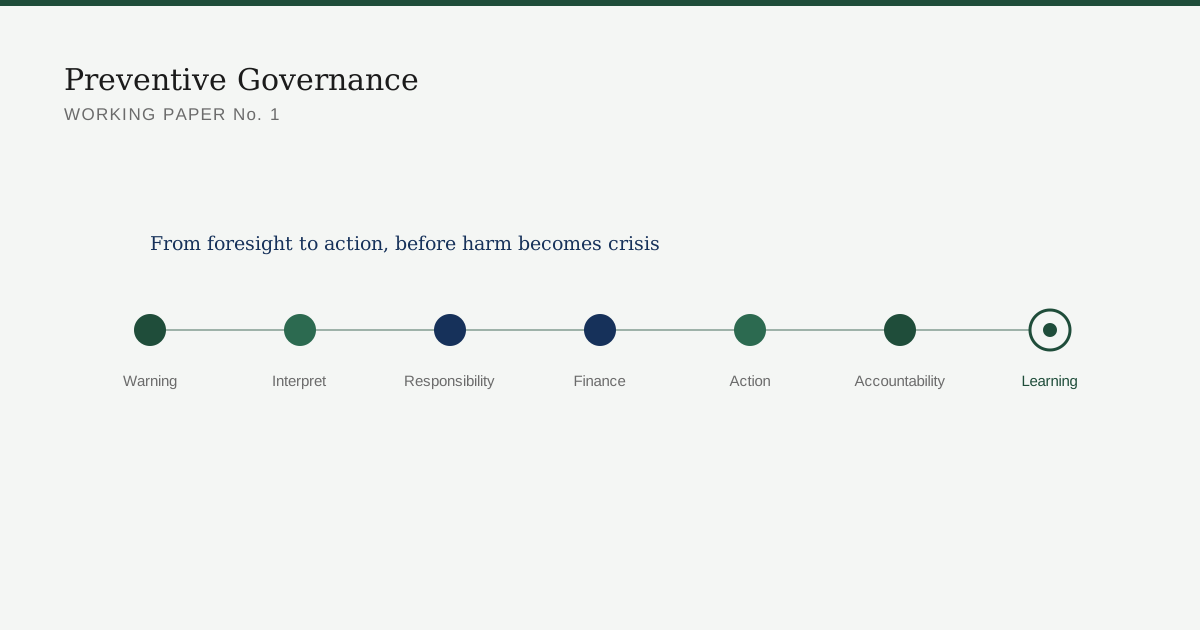
Prevention is best understood not as an event but as a chain: warning, interpretation, mandate, finance, action, accountability, and learning. A crisis that was foreseeable and happened anyway is a chain that broke at an identifiable link.
The chain runs from a signal of emerging harm to a system that has acted in time and learned from the result. Each link is necessary; the chain is only as strong as its weakest. The diagnostic value of the model is precisely that it forces a specific question — not whether an institution is good at prevention in general, but where, in this particular case, the warning-to-action chain broke, and why. It resists the temptation to attribute failure to a vague deficit of will and instead demands localization: the warning was clear but misread; the interpretation was sound but no actor held the mandate; the mandate existed but the money arrived too late; the action was funded but never reached the field. Each verdict implies a different reform.
Detection asks whether the institution can see emerging harm early. It spans conflict early warning, climate and disaster risk, health surveillance, financial-fragility monitoring, social-unrest indicators, and technological risk assessment. It is the link that has received the most investment and is least often the binding constraint — a fact that should reorient where effort goes next. Interpretation asks whether the institution can understand what the signal means; many warnings fail here, received but misread, discounted, or stripped of the context that would make them actionable.
Responsibility asks who is accountable to act — the stage at which the doctrine becomes distinctive, because the answer is so often 'no one in particular.' A preventive system answers that question in advance, assigning a mandate before the crisis rather than apportioning blame after it. Financing asks whether money is available before the crisis; prevention fails, more than anywhere else, here, because money arrives after disaster, when it is most expensive and least effective. A serious architecture builds financing that disburses on anticipation — crisis windows, contingent credit, resilience bonds, anticipatory humanitarian finance, and prevention-weighted lending that treats risk reduction as a return in its own right.
Action asks whether the institution can act in time. It has a graduated character that the language of crisis obscures: prevention is rarely a single decisive move but a sequence of proportionate steps taken as a risk matures. The earlier a step is taken, the smaller and cheaper it can be, which is precisely why early action is so often declined — its modesty makes it look optional, and its success ensures that the larger step it forestalled is never seen. A mature preventive system rewards the small early move on its merits, rather than waiting for the risk to grow large enough to make action feel justified.
Learning asks whether the system learns from near-misses and failures. Without it, the same chain breaks at the same link the next time. Prevention depends on remembering what was foreseen and what was done about it, yet memory decays as staff rotate and the crisis recedes from view. A preventive system treats memory as infrastructure: it records its warnings and responses, preserves the reasoning behind decisions taken and declined, and carries that record forward so that anticipation compounds across cycles rather than resetting with each one.
Across cases, the chain does not break at random. Detection, the most heavily resourced link, is rarely the binding constraint. The failures cluster downstream — at responsibility, where no actor holds a clear mandate; at financing, where money is structured for relief rather than anticipation; and at implementation, where mandates and budgets exist on paper but do not convert into operational capacity. This has a direct implication: the marginal returns to more detection are now low relative to the returns from repairing the links that follow it.
If the warning-to-action chain describes the mechanism of prevention, the Prevention Gap names its characteristic failure. It is the measurable space between foresight and action — the gap into which foreseeable crises fall. The gap is not a single deficiency but the joint product of the forces named throughout this paper: fragmented mandates that leave no one responsible; political short-termism that discounts the future; the invisibility of prevention's benefits; weak or late financing; bureaucratic risk-aversion that punishes early movers; genuine uncertainty about which warnings will prove true; accountability that arrives only after failure; and a public that demands visible response rather than invisible prevention. Naming the gap reframes the goal of reform: the aim is not to perfect detection, which is already comparatively strong, but to shorten the distance between what is known and what is done.
Prevention is a public good. Its most important instances are a special class whose entire value lies in the harm they avert — and which society therefore chronically underfunds.
A public good is non-rival and non-excludable: one actor's benefit does not diminish another's, and none can be cheaply excluded from it. Such goods are undersupplied because their producers cannot capture their full value. Prevention fits the definition precisely. A stable financial system, an uncontaminated information environment, a contained outbreak, a defused conflict — each benefits everyone, excludes no one, and rewards its provider with almost nothing visible. Prevention is thus a public good with an additional handicap: its benefit is not merely diffuse but temporal and counterfactual, realized as an absence rather than a presence.
Within this category sits a still more demanding subclass: preventive public goods, whose value consists entirely in catastrophic losses that did not occur — conflict mediation, pandemic surveillance, disaster early warning, information integrity, cybersecurity, climate adaptation, financial stability, food security, and safe infrastructure. These deserve particular attention precisely because society rarely notices them until they fail. Their success is silence; their failure is a headline. That asymmetry of salience is the deep reason they are underfunded, and the deep reason a measurement agenda is needed to make their value legible.
The undersupply is most severe at the international level, where preventive public goods are not only invisible but unowned. Within a state, a finance ministry can in principle be made to fund domestic prevention; across states, no authority can compel the provision of goods whose benefits spill across every border. The actors best placed to supply them capture only a fraction of the benefit, so each rationally provides less than the collective optimum, and the global stock of prevention sits chronically below what even narrow self-interest would justify.
The valuation problem is what makes preventive public goods so hard to fund. A good whose benefit is a non-event cannot be valued by what happened; it must be valued against a counterfactual — the crisis that would have occurred absent the investment. Counterfactuals are contestable, and contestable benefits lose budget fights to concrete costs. This is not an argument for abandoning valuation but for taking it seriously: the discipline of estimating avoided harm, openly and with stated uncertainty, is the only way to give prevention a number to defend itself with. A defective estimate of an invisible benefit still competes better than no estimate at all.
Provision also confronts the free-rider problem in acute form. Because preventive public goods benefit all and exclude none, every actor has an incentive to let others pay — and the result is collective underprovision even when the aggregate benefit vastly exceeds the cost. The mechanisms that address this are familiar in outline and underused in practice: burden-sharing arrangements that distribute cost in proportion to capacity or contribution to the risk; mandated contribution where a sector's conduct generates the hazard; pooled financing that spreads both cost and benefit; and measurement that names contributors and free-riders alike, so that contribution becomes reputationally legible.
If institutional authority entails preventive responsibility, then the firms and platforms that now shape public life inherit duties they have not been asked to bear.
For most of its history, prevention has been imagined as the work of states and the organizations they create. That imagination is now incomplete. A handful of private actors exercise functions — over the information environment, critical infrastructure, financial stability, and the trajectory of artificial intelligence — that are governmental in everything but name. The principle that authority entails preventive responsibility applies to them with full force.
Corporate preventive responsibility builds on, but goes beyond, the established floor of business and human rights — the duty to do no harm, expressed through due diligence and reflected in instruments from the United Nations Guiding Principles to emerging mandatory due-diligence law. A preventive standard asks more than the avoidance of direct harm. It asks firms to anticipate and prevent the foreseeable externalities of their products and business models; to disclose the systemic risks they can see and others cannot; to invest in the public goods their sectors depend on; to cooperate with public institutions rather than arbitrage them; and, above all, to avoid amplifying fragility for private gain.
Among these duties, disclosure deserves emphasis as a distinct obligation. Private actors often hold the earliest and most accurate view of a systemic risk — the insurer who sees a region becoming uninsurable, the lender who sees leverage building, the platform that sees a coordinated manipulation campaign forming. Where that knowledge is privately held and publicly consequential, a preventive standard treats its disclosure not as a courtesy but as a responsibility, because the warning that never leaves the firm cannot enter the chain at all. Disclosure converts private foresight into a public early-warning asset.
The standard invites two serious objections, and the doctrine must meet them rather than dodge them. The first is that it asks firms to assume governmental roles they are neither elected nor accountable to perform. The answer is that the duty is not to govern but to prevent foreseeable harm proportionate to one's own capacity and causal contribution — a far narrower claim, and one already embedded in ordinary tort and due-diligence law. The second objection is that voluntary preventive responsibility invites performance without substance: pledges, reports, and the appearance of contribution in place of the thing itself. This is a real risk, and it is precisely why the doctrine refuses to rest on good intentions. Without verification and comparable measurement, corporate preventive responsibility collapses into public relations.
A doctrine of prevention that cannot be measured cannot be rewarded — and what is not rewarded will not be done. Measurement is therefore not an appendix to the theory but its completion.
The invisibility of prevention's benefits is its central political handicap. The remedy is to make the invisible legible: to render anticipatory capacity, contribution, and avoided harm into quantities that can be compared, debated, and improved. This is a measurement agenda rather than a finished instrument — a direction of work in which no measure claims final precision and each is meant to be cited, contested, and refined.
Such an agenda would span several kinds of measure, each addressing one dimension of the Prevention Gap. One would diagnose an institution's anticipatory capacity and locate its binding constraint. Another would situate that institution in a wider field, gauging how much it contributes to the shared capability on which prevention depends. A third would expose whether resources are structured for anticipation or for relief. A fourth would make the warning-to-action chain empirical, identifying the link that breaks most often. And a fifth would attempt the hardest and most important task of all — attaching a number to the crisis that did not happen, so that prevention can compete for credit on something like equal terms with response.
Measurement is not a neutral act of observation; it is an intervention. What gets measured gets managed, and what gets published gets contested and improved. An institution that knows its readiness will be examined and its performance tracked faces an incentive structure different from one whose prevention performance is invisible. The purpose of a measurement agenda is precisely to alter that structure — to manufacture, through visibility, some of the reward for prevention that the architecture of delay withholds.
Two cautions discipline this ambition. The first is Goodhart's warning: when a measure becomes a target, it can be gamed, and a readiness measure optimized for appearances is worse than none. The second is the temptation of false precision — dressing irreducible uncertainty in decimal points. Both are answered by treating any such measure's output as a flag for inquiry rather than a verdict, by reporting the sensitivity of every figure to the choices behind it, and by publishing methodology openly so that measures can be challenged. A measure offered honestly, with its uncertainty visible, informs judgement; a measure offered as an oracle corrupts it.
The value of a general doctrine is that the same diagnostic applies across domains usually governed in isolation. In each, the question is identical: where does the warning-to-action chain break?
In conflict, early-warning systems are mature and the chain typically breaks at responsibility and financing. In disasters, forecasts are increasingly precise, and anticipatory finance that disburses on a forecast rather than a declaration is the reform with the highest return. In health, surveillance improved after recent pandemics, but capacity, financing, and implementation remain the weak links. In climate, the science is the strongest detection system humanity has built, and the failure is downstream, in incentives, financing, and the misallocation of adaptation capital away from the most exposed. In migration, drivers are foreseeable months or years ahead, yet response remains overwhelmingly reactive. In artificial intelligence and information integrity, detection is not the constraint — the capability curve and its harms are visible — but incentives, capacity, and implementation lag on a predictable schedule. And in economic and financial crises, fragilities are often named by surveillance well before they crystallize, with the chain breaking at the political will to impose near-term costs against a deferred benefit.
The pattern across these domains is the paper's empirical claim in miniature. Detection is rarely the binding constraint. The chain breaks, again and again, at responsibility, financing, and implementation — the links that require an actor to bear a certain cost now for an uncertain benefit later. Because detection is comparatively strong, the highest-return reforms are those that pre-assign responsibility and pre-position finance: naming a duty-bearer for each class of foreseeable harm, and building instruments that disburse on a forecast rather than a declaration. A clear mandate is hollow without committed money, and anticipatory money is wasted without a mandated actor to spend it.
The governing institutions of the modern world are exceptionally good at responding to crises and remarkably poor at preventing them. This is not a paradox of competence. It is a predictable consequence of how incentives, cognition, mandates, and finance are arranged — an architecture of delay that rewards visible response and starves invisible prevention. The central challenge of modern governance is not ignorance. It is the repeated failure to convert foresight into responsibility, financing, and action.
Preventive governance is the doctrine this paper offers in answer. It draws together the responsibility to protect, human security, public-goods theory, early warning, and development finance into a single framework; it locates the recurring failure in the Prevention Gap between what is foreseen and what is prevented; it treats prevention as a public good whose provision now implicates private as well as public power; and it insists that what cannot be measured cannot be rewarded. Its ambition is not to abolish crisis — some shocks are genuinely unforeseeable — but to ensure that the foreseeable ones are met before they arrive.
That will require a change in what governance rewards. So long as institutions earn credit only for the crises they resolve, they will continue to underinvest in the ones they could have prevented. The next generation of governance must reward actors not only for solving crises but for preventing them — must build the norms, mandates, financing, data systems, and accountability through which foreseeable harm is met with early action.
An occasional note when we publish a new essay, brief, or framework in preventive governance. Infrequent, and easy to unsubscribe.